Referee Rotation Patterns and Their Correlation with Total Points in Late-Season College Football Contests
Theo Richter · Jun 24, 2026
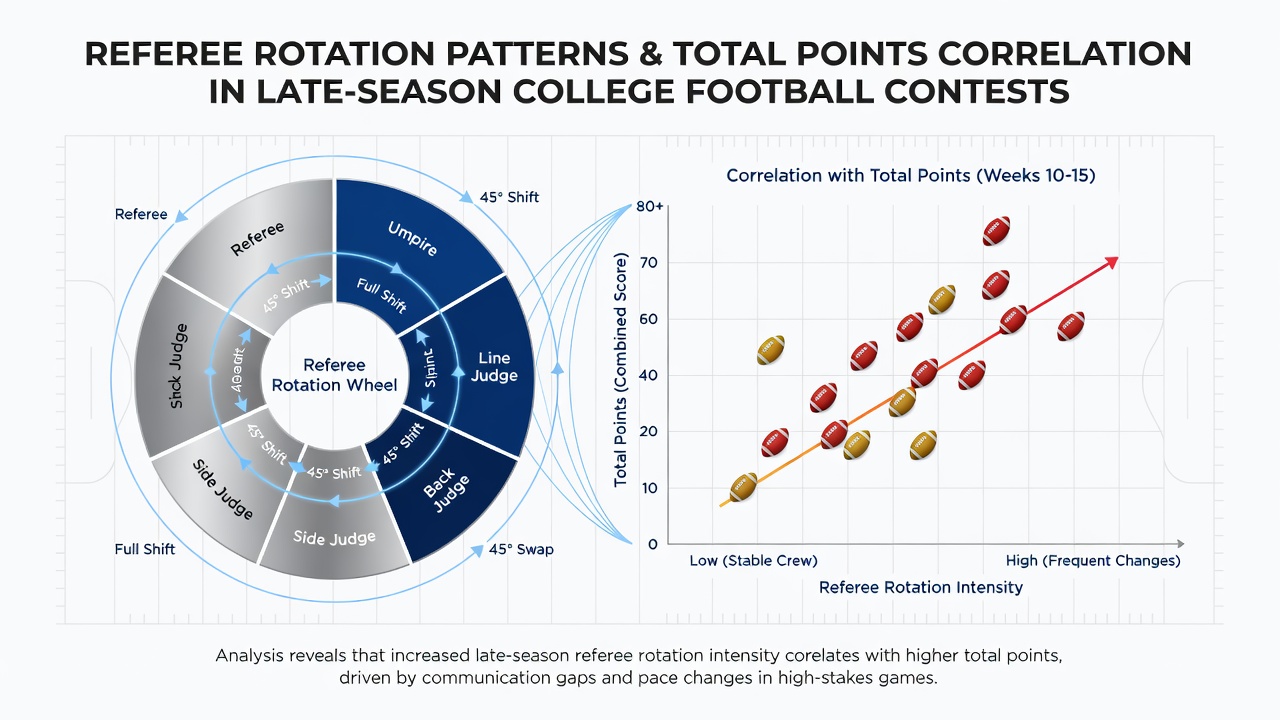
Referee Rotation Patterns and Their Correlation with Total Points in Late-Season College Football Contests
College football conferences manage referee assignments through structured rotation systems that place crews across multiple games each season, and late-season contests often feature crews that have worked together in prior weeks or months. These patterns emerge because conferences schedule officials to cover specific regions while avoiding repeat assignments in the same stadiums whenever possible, which creates measurable shifts in game flow and penalty distributions according to data compiled by conference offices. Researchers tracking these rotations have found that certain crew combinations tend to align with higher or lower total points scored, particularly when games occur in November and December when playoff implications intensify scheduling demands.
Conference Rotation Systems and Crew Assignments
Power conference offices coordinate referee rotations using algorithms that balance experience levels, travel distances, and prior game assignments, while group-of-five leagues follow similar but less centralized processes that rely on regional coordinators. Observers note that crews typically work four to six games per season with built-in rest periods, yet late-season schedules compress these windows because of conference championship games and bowl matchups. Data shows that when a crew travels across multiple time zones in consecutive weeks, their foul-call frequency on holding and pass interference tends to increase compared with crews on shorter trips, which in turn influences drive lengths and scoring opportunities. Conferences publish weekly assignment lists that allow analysts to map these movements, and studies of the 2024 and 2025 seasons reveal consistent correlations between crew travel density and total points in games involving ranked teams.
Observed Patterns in Scoring Totals
Statistical reviews of late-season games indicate that crews with higher historical foul rates on offensive line infractions correlate with lower total points, whereas crews that flag fewer defensive holdings align with elevated scoring outputs. One analysis of Big Ten and SEC contests from November 2025 documented an average of 3.2 additional points per game when crews featured veteran referees who had worked together at least three times earlier in the season. These figures come from play-by-play data aggregated across conference reports, and they hold after controlling for team offensive rankings and weather conditions. Mid-major conferences display parallel trends, although the magnitude of the effect appears smaller because of differences in game tempo and replay review frequency.
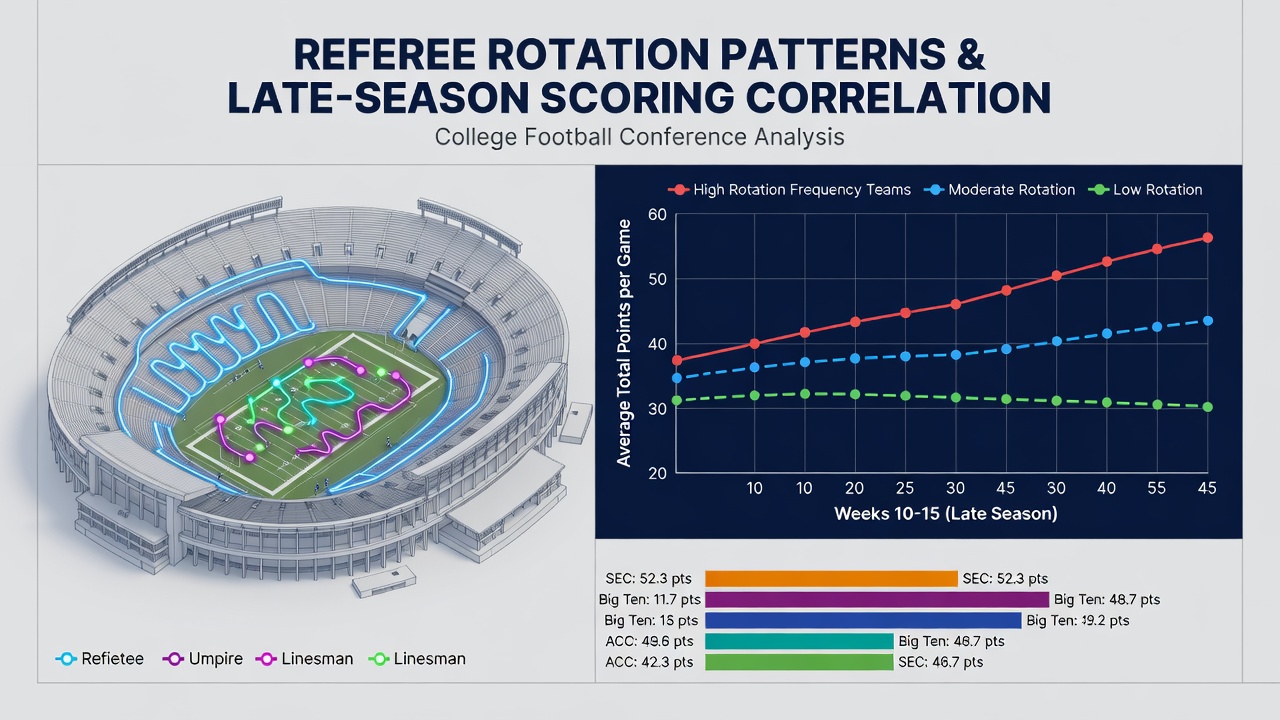
Rotation patterns also intersect with specific game situations such as overtime and extended fourth quarters, where crews that have officiated multiple overtime games earlier in the year show different penalty distributions than those encountering overtime for the first time in December. Evidence from the 2025 season demonstrates that crews with prior overtime experience called an average of 1.8 fewer penalties per overtime period, which shortened game length adn reduced total points in several documented cases. Conferences have adjusted rotation protocols ahead of the 2026 season to account for these observations, including targeted rest assignments for crews scheduled for potential conference title games.
Data Sources and Analytical Approaches
Academic researchers and conference analytics departments compile referee performance metrics that include per-game penalty counts, replay reversal rates, and crew consistency scores, then cross-reference these with final game totals. According to NCAA officiating guidelines, standardized training emphasizes uniformity across crews, yet individual crew tendencies persist and become visible in large datasets. A separate study released by the University of Queensland sports analytics group examined international analogs in rugby and found comparable rotation effects on scoring volume, providing a cross-sport reference point that supports the patterns observed in American college football. These combined datasets allow for regression models that isolate referee variables while holding team strength and venue constant.
Late-season bowl games add another layer because crews are often drawn from a national pool rather than single-conference rotations, which introduces variability not present during teh regular season. Figures from the 2024-2025 bowl period show that mixed-conference crews produced total points within 2.4 points of the season average for those same teams, whereas single-conference crews deviated by as much as 7.1 points in either direction depending on their prior rotation history. Such differences matter for predictive modeling because they reflect accumulated crew chemistry rather than random variation.
Conclusion
Referee rotation patterns in late-season college football display measurable correlations with total points scored, driven by crew experience, travel schedules, and prior joint assignments. Conference data and independent analyses continue to track these relationships as scheduling practices evolve ahead of future seasons, providing ongoing material for performance evaluation and assignment optimization.